What one kilo really costs you
- Add up the raw material for one batch: chillies, coriander, onion, garlic, oil, salt, whatever goes in.
- Weigh the batch at the end. Roasting and grinding lose weight, so a batch of 5 kg of raw material does not give 5 kg of masala.
- Add the grinding charge, the packets, labels and boxes, and the gas or electricity for the batch.
- Divide the total by the kilos you actually got. That is your cost to make one kilo.
An example, to show the arithmetic only: ₹1,450 of raw material, ₹90 for grinding and ₹120 of packets and labels is ₹1,660. If the batch gives 4.5 kg, one kilo costs ₹369 to make.
Two prices: one for homes, one for shops
A shop that buys from you has to sell at a profit too, so it needs a lower rate than a neighbour pays. Set the wholesale rate first, above your cost with a margin you can live with, then set the home price above it.
- Ask the shop what it will sell your packet for, and what margin it needs.
- Check the wholesale rate still leaves you a margin over your cost to make.
- Keep both prices fixed for everyone of each kind, so nobody asks for the other one.
What the packet label should carry
A food packet you sell should show your business name, the product, the weight, the packed date and a best-before date, and your FSSAI registration or licence number. Most small home food businesses need at least an FSSAI basic registration: check what applies to you on the FSSAI site (foscos.fssai.gov.in). This is general information, as of November 2026, not advice for your case.
How DukanUp does this for you
Each item can carry a selling price, a cost to make and a wholesale price. Mark a shop as a wholesale customer and the till prices its bill at the wholesale rate. For a home business, the profit report counts profit from each item’s cost to make by default.
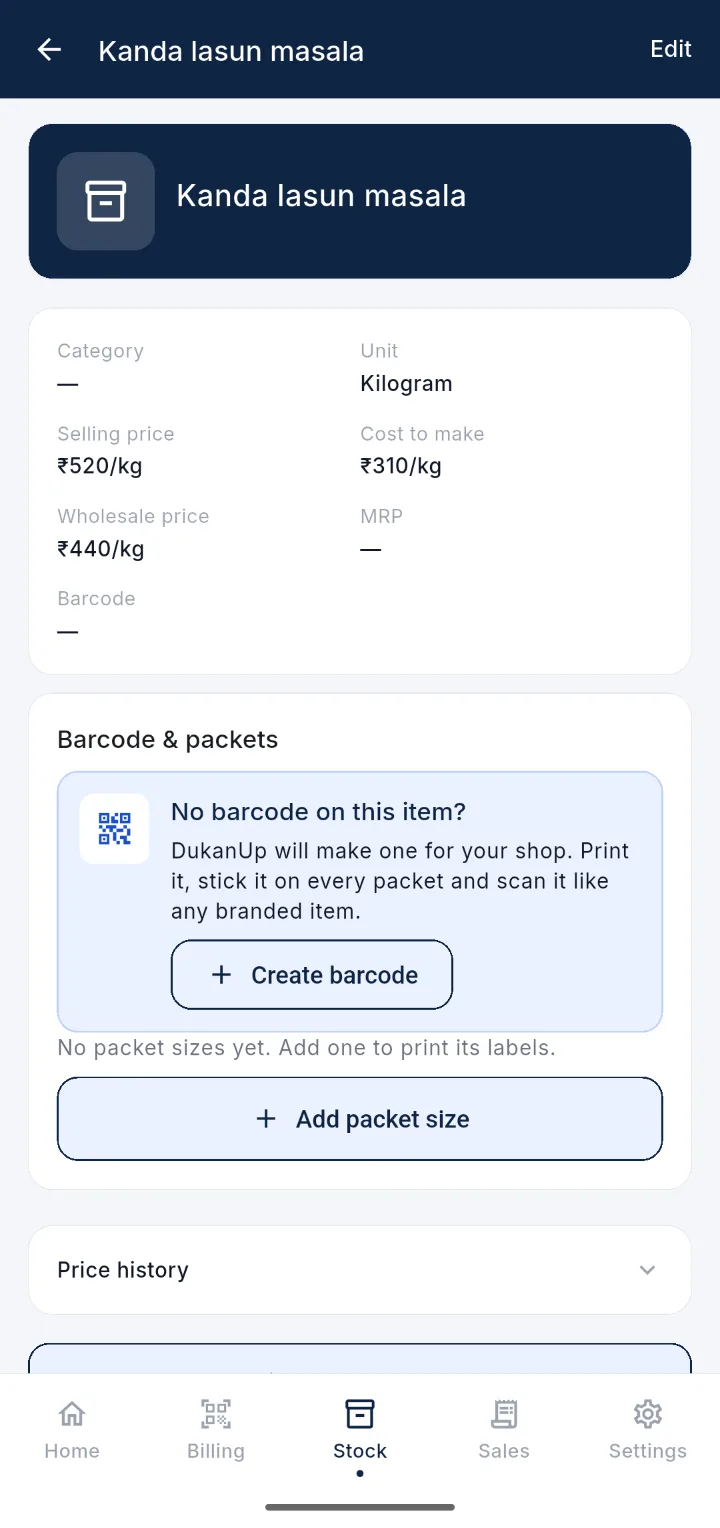
Add your FSSAI number once and it prints on your invoice. A packet label carries the packed date, a best-before date worked out from the shelf life you set, and the FSSAI number. No barcode on your own packets? DukanUp makes one for your shop, so a shop that buys from you can scan it like any branded packet.
Honest limits: DukanUp does not keep recipes or count raw material down as you make a batch. The cost to make is one number you set for each item.
Questions
Do I need GST to sell homemade masala?
Not to use DukanUp: GST and FSSAI numbers are both optional in the app. Whether you need to register for GST depends on your turnover and where you sell, so ask your CA.
Can I keep two prices, one for shops and one for homes?
Yes. Each item can carry a wholesale rate, and a customer can be marked wholesale. The retail price stays for everyone else.
How often should I recheck my cost?
Whenever your main raw material changes price, and at least once a season. Chillies and oil move a lot; a price that was right in winter can be a loss in summer.
